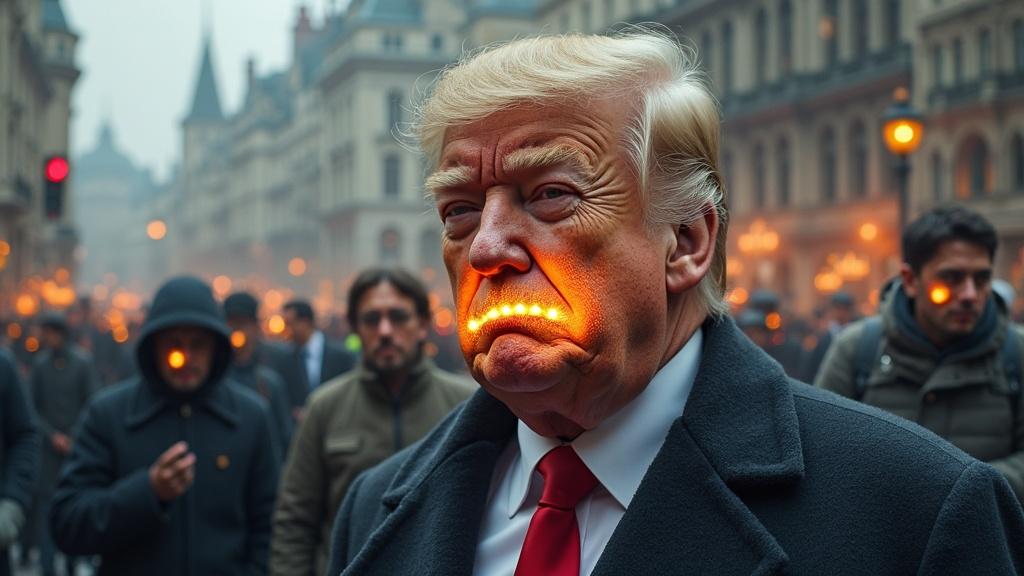
Geopolitical Uncertainty Deepens Global Fragmentation
The world is witnessing a profound escalation in geopolitical uncertainty, marked by ongoing conflicts in Ukraine and the Middle East, as well as heightened tensions between the United States and China. These developments are not only testing the resilience of international relations but also disrupting global supply chains, potentially leading to significant economic repercussions.
Ongoing Conflicts: A Global Challenge
The conflict in Ukraine, now in its second year, continues to pose a significant challenge to global stability. The situation remains volatile, with both sides suffering heavy losses and a peaceful resolution seeming increasingly distant. Meanwhile, in the Middle East, long-standing tensions between various nations continue to simmer, threatening to boil over into full-scale conflict at any moment. These ongoing conflicts are not only causing immense human suffering but also contributing to the deepening of global fragmentation.
US-China Tensions: A New Cold War?
The relationship between the United States and China has become increasingly strained in recent years, with tensions escalating over issues such as trade, security, and technology. Many observers are now warning of a new Cold War between the two superpowers, with potentially far-reaching consequences for the global economy and international relations. The US-China tensions are further exacerbating the sense of geopolitical uncertainty, making it more difficult for nations to navigate the complex web of international relations.
Disruption of Global Supply Chains
One of the most significant consequences of the ongoing conflicts and US-China tensions is the disruption of global supply chains. Many multinational corporations rely on complex networks of suppliers and manufacturers located in different parts of the world. However, with the current level of geopolitical uncertainty, these supply chains are becoming increasingly vulnerable to disruption. For example, the conflict in Ukraine has already led to shortages of certain commodities, such as wheat and corn, while the US-China tensions have resulted in restrictions on the export of certain technologies. As a result, companies are being forced to rethink their supply chain strategies, with some opting to diversify their suppliers or relocate their manufacturing operations to more stable regions.
Economic Repercussions
The disruption of global supply chains is likely to have significant economic repercussions, including higher costs, reduced efficiency, and decreased competitiveness. For instance, a recent report by the International Monetary Fund (IMF) warned that the ongoing conflicts and US-China tensions could lead to a decline in global trade, resulting in lower economic growth and higher unemployment. Furthermore, the World Bank has also expressed concerns about the impact of geopolitical uncertainty on the global economy, highlighting the need for nations to work together to address these challenges.
Regional Implications
The geopolitical uncertainty is also having significant regional implications. For example, the conflict in Ukraine has led to a significant increase in military spending in Eastern Europe, while the US-China tensions have resulted in a strengthening of military alliances in the Asia-Pacific region. Additionally, the European Union is facing significant challenges in its relations with both the United States and China, highlighting the need for the EU to develop a more cohesive and effective foreign policy.
Conclusion
In conclusion, the ongoing conflicts in Ukraine and the Middle East, alongside the US-China tensions, are deepening global fragmentation and disrupting global supply chains. The economic repercussions of these developments are likely to be significant, with higher costs, reduced efficiency, and decreased competitiveness. As the world becomes increasingly interconnected, it is essential for nations to work together to address these challenges and promote a more stable and secure international environment. For more information on the ongoing conflicts and their impact on global politics, readers can refer to Ukraine peace talks and EU-Mercosur agreement.